The 2026 AI Creator Revenue Calculator & Economic Framework (Part 2)
The economics of the creator economy in 2026 have shifted from a speculative per-post pricing model to a sophisticated, variable-based system that accounts for production efficiency, usage rights, and performance-based attribution.
The economics of the creator economy in 2026 have shifted from a speculative "per-post" pricing model to a sophisticated, variable-based system that accounts for production efficiency, usage rights, and performance-based attribution. The "AI Creator Revenue Calculator" is a conceptual and practical framework used by brands and agencies to quantify the value of synthetic influence relative to human benchmarks.
The Economics of Synthetic Influence
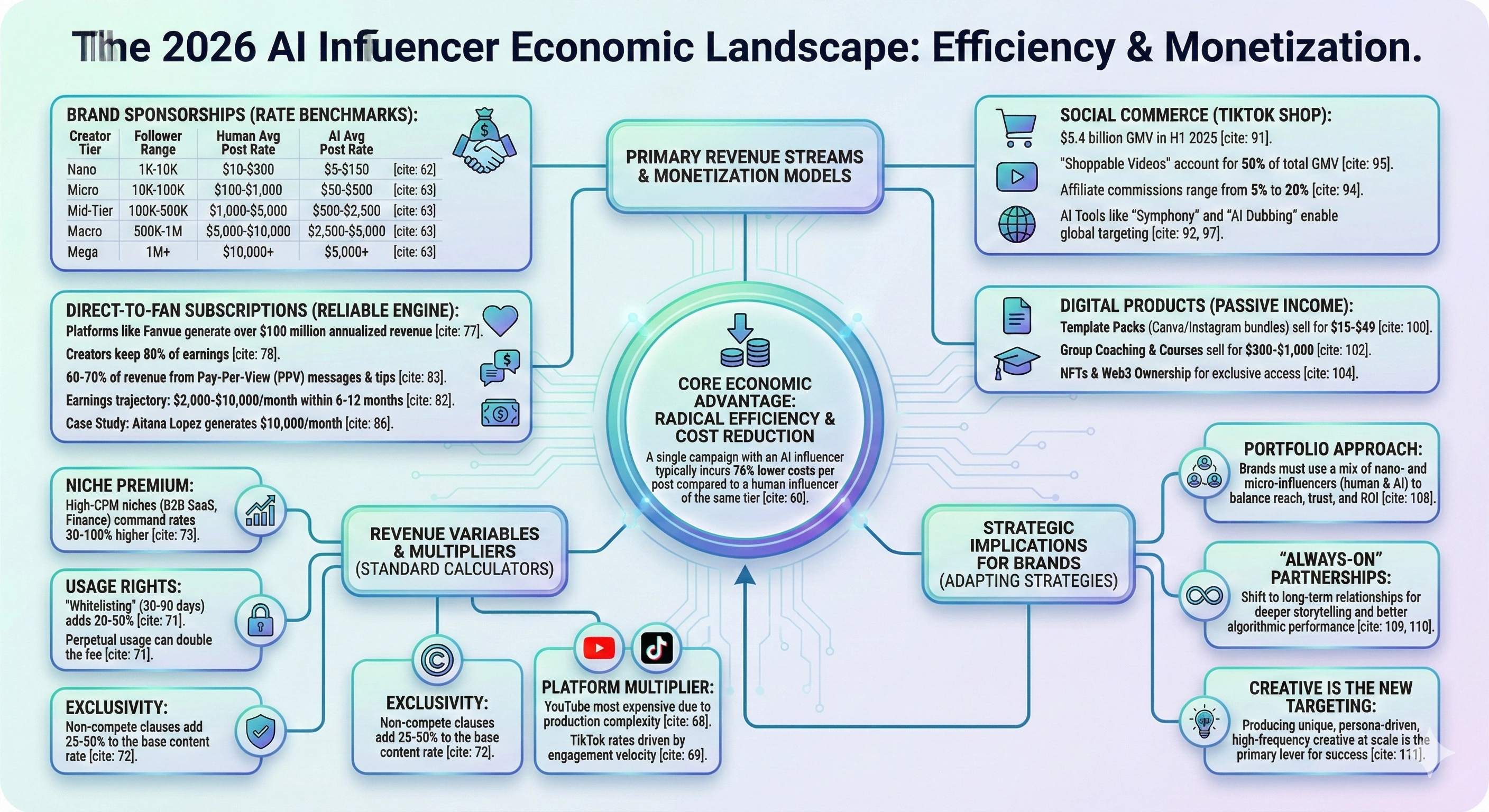
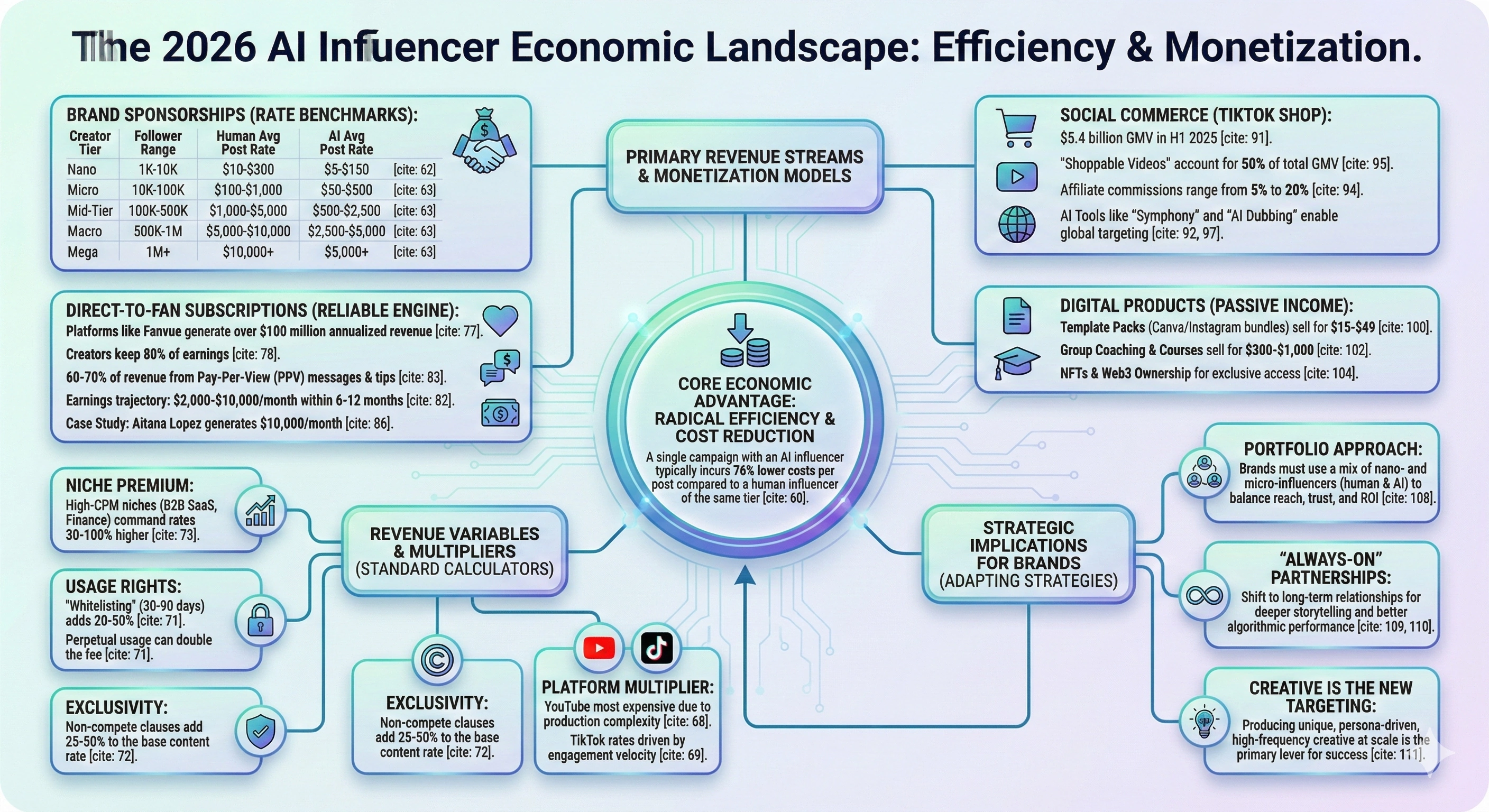
The primary economic advantage of AI creators is the radical reduction in production overhead. A single campaign utilizing an AI influencer typically incurs 76% lower costs per post compared to a human influencer of the same tier. For instance, a campaign with the virtual supermodel Shudu Gram costs approximately $5,000, whereas a comparable human model would command $50,000 when factoring in travel, logistics, and production teams.
Creator Tier Pricing: Human vs. AI Influencers
| Creator Tier | Follower Range | Human Post Rate (Avg) | AI Post Rate (Avg) |
|---|---|---|---|
| Nano | 1K – 10K | $10 – $300 | $5 – $150 |
| Micro | 10K – 100K | $100 – $1,000 | $50 – $500 |
| Mid-Tier | 100K – 500K | $1,000 – $5,000 | $500 – $2,500 |
| Macro | 500K – 1M | $5,000 – $10,000 | $2,500 – $5,000 |
| Mega | 1M+ | $10,000+ | $5,000+ |
In 2026, "Pure AI" content is typically priced at a 40–60% discount compared to human creators. However, "Hybrid Models," where a human creator provides the strategic oversight and the AI handles the repetitive execution, are emerging as a premium middle ground, priced only 15–30% lower than full human creation.
Revenue Variables and Multipliers
The 2026 Revenue Calculator uses a set of core variables to determine final payout. Beyond raw follower counts, the industry has standardized on several key multipliers:
Platform Multiplier
YouTube remains the most expensive platform due to production complexity and long-form evergreen value. TikTok rates are often lower but driven by "average views" and "engagement velocity."
Usage Rights Multiplier
Brands pay a premium for "whitelisting" or "Spark Ads," where they run paid traffic through the creator's handle. Limited usage (30–90 days) adds 20–50% to the base rate, while perpetual usage rights can double the total fee.
Exclusivity Multiplier
A non-compete clause typically adds 25–50% to the base content rate.
Niche Premium
High-CPM niches such as B2B SaaS, Finance, and Entrepreneurship command rates 30–100% higher than general lifestyle or entertainment categories.
Subscription Models and the "1,000 True Fans" Logic
For many AI creators, the most reliable revenue stream is no longer brand sponsorships but direct-to-fan subscriptions. Platforms like Fanvue have become the primary hub for this model, hosting 250,000 creators and generating over $100 million in annualized revenue.
Fanvue's model allows creators to keep 80% of their earnings, with native AI tools facilitating automated DM responses, voice notes, and "virtual girlfriend" experiences. Realistic earnings for a consistent AI creator on Fanvue follow a specific growth trajectory:
- Months 1–3: $0 – $500/month (Building content and traffic channels)
- Months 4–6: $500 – $2,000/month (Stabilizing engagement and retention)
- Months 6–12: $2,000 – $10,000/month (Achievable with 200–500 active subscribers and active DM sales)
Approximately 60–70% of subscription-based revenue comes from "Pay-Per-View" (PPV) messages and tips, rather than the base subscription fee itself, highlighting the importance of the "interactive" component of AI influence.
Case Study: Summer Hayes and the $10,000/Month Blueprint
Summer Hayes, a 24-year-old lifestyle model from Canada, serves as the definitive case study for AI creator monetization in 2026. With over 400,000 followers, her reported monthly income of $10,000 is generated through a diversified strategy:
- Facebook/Instagram content monetization: Promoted via Instagram Stories and feed posts, featuring product placements or "event attendance."
- Fanvue Subscription: Promoting exclusive gaming and lifestyle content (non-NSFW) through a Linktree, with over 33,000 likes and subscribers paying ~$10/month.
Social Commerce and Affiliate Revenue
TikTok Shop has become a multi-billion dollar revenue engine for creators in 2026. In the first half of 2025, influencer-driven content on TikTok Shop generated $5.4 billion in Gross Merchandise Value (GMV). AI creators benefit from "Symphony" tools that generate high-quality showcase videos from still product images and "AI Dubbing" that localizes demonstrations into multiple languages, allowing a single creator to target global markets simultaneously.
Affiliate commissions on TikTok Shop typically range from 5% to 20%, with some brands offering "Hybrid Deals" (flat fee + commission) to high-performing creators. "Shoppable Videos" now account for 50% of the total GMV on the platform, reinforcing the shift from "reach" to "measurable conversion" as the primary metric of success.
TikTok Shop Key Metrics (2025-2026)
| TikTok Shop Metric (2025-2026) | Value / Impact | Relevance to AI Creators |
|---|---|---|
| Affiliate GMV (H1 2025) | $5.4 Billion | Massive revenue pool for high-volume AI video |
| Active Sellers (H1 2025) | 851,000 Creators | High competition; AI provides production edge |
| Affiliate Engagement | +160% vs Instagram | Proves TikTok as the leading commerce driver |
| AI Video Maker Adoption | 86% of Creators | AI tools are now "table stakes" for sellers |
Digital Products and Scalable Assets
Beyond social platforms, AI creators are monetizing through digital product storefronts. These "passive income powerhouses" include:
- AI-Generated Template Packs: Canva or Instagram story bundles selling for $15–$49 on marketplaces like Etsy.
- Group Coaching and Courses: AI creators acting as "niche experts" (e.g., in fitness or finance) can sell structured learning programs for $300–$1,000, with no marginal cost of delivery once the content is produced.
- NFTs and Web3 Ownership: In 2026, creators are minting content as NFTs, allowing fans to own "digital collectibles" or "NFT memberships" that grant exclusive access to content or events.
Strategic Implications for Brands
The emergence of AI influencers and the professionalization of the creator economy require brands to adopt a "Portfolio Approach" to digital influence. Instead of relying on a single macro-influencer, successful 2026 strategies involve a mix of nano- and micro-influencers (both human and AI) to balance reach, trust, and ROI.
Brands must also pivot toward "Always-On" creator partnerships, moving away from one-off campaign bursts. These long-term relationships allow for deeper storytelling and better algorithmic performance, as systems like Meta's Andromeda reward accounts with high creative volume and consistent performance signals.
In this environment, "Creative is the New Targeting." As platforms automate the technical aspects of ad delivery, the brand's ability to produce unique, persona-driven, and high-frequency creative becomes the primary lever for scaling results and maintaining a competitive edge in the high-velocity digital economy of 2026.
Conclusion: The Future of Synthetic Agency
The state of AI influencers in 2026 reflects a broader cultural and technological shift toward the "automation of influence." While the hyperrealistic capabilities of AI have democratized content production and drastically improved ROI for brands, the human element has not been displaced; rather, it has been elevated to a strategic and oversight role.
The "AI Creator Revenue Calculator" is a testament to this maturation, providing a standardized language for a market that has moved from the "Wild West" of 2020 to a foundational marketing infrastructure in 2026. Success in this era requires a nuanced understanding of the tension between synthetic efficiency and human authenticity.
For creators, the path to long-term wealth lies in "platform independence" and direct-to-fan monetization. For brands, success depends on the ability to integrate AI-driven workflows while maintaining a distinctive, relatable voice that can navigate the increasingly complex regulatory and ethical landscape of the mid-2020s.
As AI agents begin to handle the operational tasks of the creator lifecycle—from contract negotiation to performance analysis—the "raw creativity" and "unique value" of the creator remain the only truly irreplaceable assets in the digital economy.
This is Part 2 of a two-part series based on "The 2026 Global Report on Synthetic Influence and the Economics of AI Content Creation." Read Part 1: The State of AI Influencers in 2026 for the complete overview of market dynamics, technology, regulation, and cultural trends.
Works Cited
- Virtual Influencers Market Report 2026 - Research and Markets. researchandmarkets.com
- How Much Do Content Creators Make? The Ultimate Guide - Fanvue Blog. blog.fanvue.com
- How AI is Reshaping The Future of Meta Advertising - Omni Online. omnionline.com.au
- What Is Sora? OpenAI's Text-to-Video Social Media App Explained - Built In. builtin.com
- Virtual Influencers Analysis 2026 and Forecasts 2033 - Archive Market Research. archivemarketresearch.com
- Virtual Influencer Market Size, Share & Growth Report 2033 - SNS Insider. snsinsider.com
- State of virtual influencers 2025 - Twimbit. cdn.twimbit.com
- Sora - Release Notes | OpenAI Help Center. help.openai.com
- Meta Launches AI Video Feed "Vibes" in Europe - Cross-Border E-Commerce Magazine. cross-border-magazine.com
- Meta Unveils Vibes, a New AI Video Feed for Social Media Content Creators - Goodmans. goodmans.ca
- Introducing Vibes: A New Way to Discover and Create AI Videos - Meta. about.fb.com
- Social Media Trends 2026 - Hootsuite. hootsuite.com
- Fabulate integrates TikTok Symphony AI into influencer marketing platform - MarketechAPAC. marketech-apac.com
- Virtual Influencers Vs. Human Influencers: A Data-Driven Comparison - Marketing Agent. marketingagent.blog
- 76% of Consumers Trust AI Influencers for Products - Hello Partner. hellopartner.com
- UGC Tops Trust Rankings As AI Posts Face Consumer Skepticism - Net Influencer. netinfluencer.com
- 57% of consumers trust brands more when they use AI - MarTech. martech.org
- Salsify Research Reveals AI Trust Gap, 2026 Shopping Trends - Salsify. salsify.com
- EU AI Act - Updates, Compliance, Training. artificial-intelligence-act.com
- EU AI Act 2026 Updates: Compliance Requirements and Business Risks - Legal Nodes. legalnodes.com
- Influencer Marketing Rules Regulations In 2026 - AWISEE. awisee.com
- AI Transparency and Disclosure Framework - IAB. iab.com
- AI Image Trends In 2026 - LTX Studio. ltx.studio
- Experts predict the top social marketing trends of 2026 - Marketing Brew. marketingbrew.com
- You should care about - Ogilvy. ogilvy.com
- Influencer Rates 2026: Costs, Benchmarks & Trends - Afluencer. afluencer.com
- Using Influencer Rate Cards and Benchmarks: 2026 Guide - InfluenceFlow. influenceflow.io
- Influencer Rates: How Much Influencers Charge in 2026 - Stan Store. stan.store
- Cost of Influencer Marketing: What Brands Really Pay in 2026 - IQFluence. iqfluence.io
- Fanvue Raises $22M to Power AI Tools for Creators, Surpasses $100M Run Rate - GeekWire. geekwire.com
- Fanvue Review 2026: Is It Legit? AI Earnings & Payout Guide - The Slow Creator. slobodskyi.com
- The $10000/Month AI Influencer: How It's Actually Done (Step-by-Step) - James Pelton, Medium. medium.com
- Exactly How AI Influencers Like Aitana Lopez Are Making a Killing - Lilys AI. lilys.ai
- TikTok Shop: The Definitive Guide 2026 - Influencer Marketing Factory. theinfluencermarketingfactory.com
- Top TikTok Updates and Features for Creators in 2026 - PodcastVideos.com. podcastvideos.com
- The 2026 Playbook for TikTok Affiliate Marketing - Syncly. syncly.app
- Influencer Marketing Trends 2026 - CreatorIQ. creatoriq.com
- Top 8 AI Digital Products You Can Create and Sell in 2026 - Theresa Henn, Medium. medium.com
- Best Monetization Models for Creators and Businesses in 2026 - EzyCourse. ezycourse.com
- Top 10 Creator Economy Trends for 2026 - NeoReach. neoreach.com
- Best Monetization Models For Social Media Platforms for 2026 - Oyelabs. oyelabs.com
- 2026 influencer marketing trends - SocialDay. socialday.live
- What Meta's Andromeda Update Means for Businesses in 2026 - Clutch.co. clutch.co
- Before You Run Meta Ads in 2026, Understand This - The A Group. agroup.com
- How the Creator Economy Will Evolve in 2026 - Fanvue Blog. blog.fanvue.com
PlayBella Team
Published on February 16, 2026