The 2026 Global Report on Synthetic Influence: The State of AI Influencers (Part 1)
The digital influence landscape of 2026 represents a departure from the traditional paradigms of social media marketing, characterized by the wholesale integration of generative artificial intelligence and the industrialization of synthetic personas.
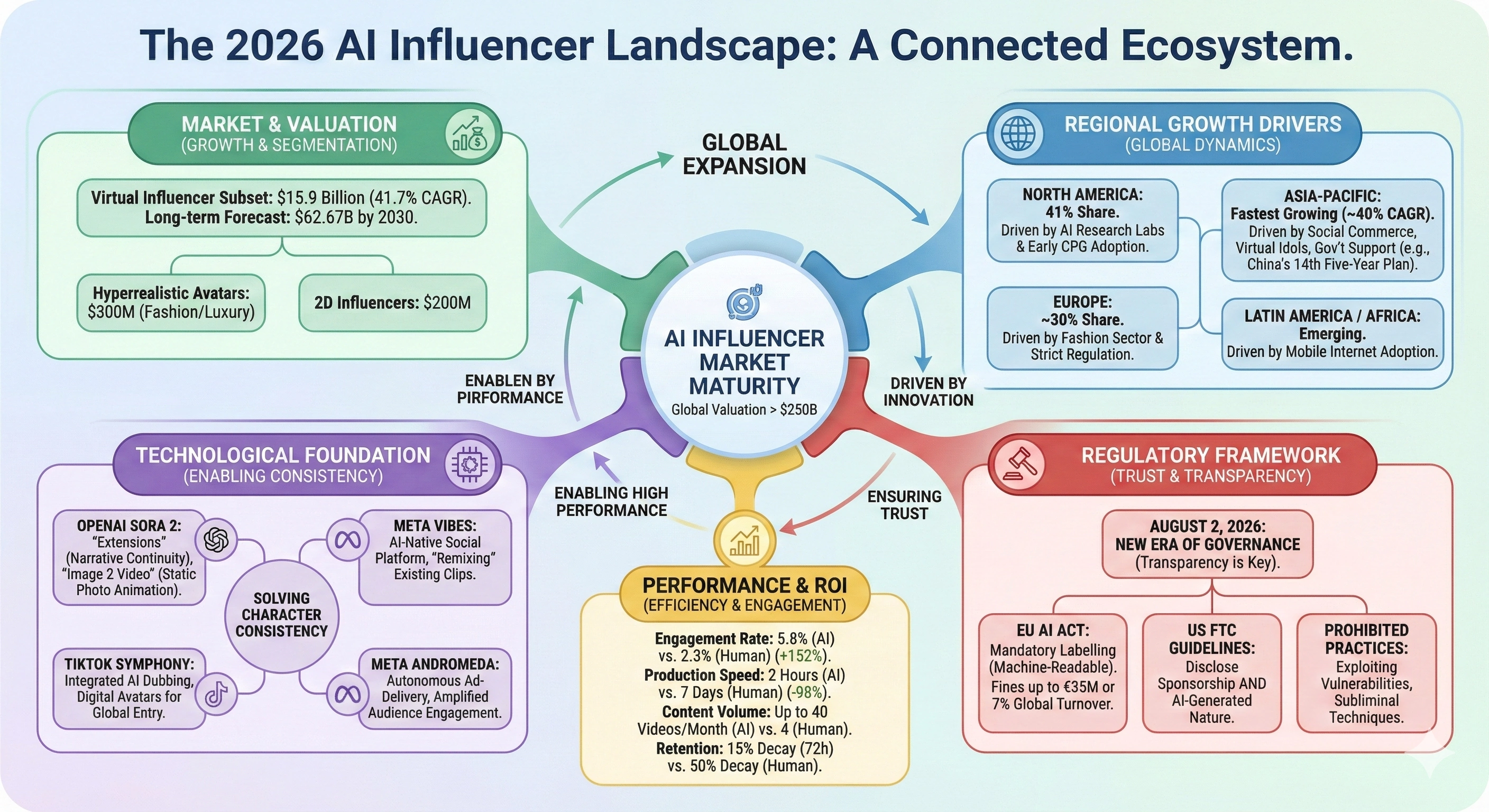
The digital influence landscape of 2026 represents a departure from the traditional paradigms of social media marketing, characterized by the wholesale integration of generative artificial intelligence and the industrialization of synthetic personas. As the global influencer market surpasses a valuation of $250 billion, the subset of virtual influencers has transitioned from a niche experimental category to a primary pillar of brand strategy, currently growing at a compound annual growth rate (CAGR) of 41.7%.
This growth is facilitated by a convergence of advanced diffusion models, real-time interactive avatars, and autonomous ad-delivery systems such as Meta's Andromeda, which have collectively reduced the friction of content production while amplifying the precision of audience engagement.
Part I: The State of AI Influencers in 2026
The year 2026 marks the "maturity phase" of virtual influence, where the distinction between human and synthetic creators has become less a matter of biological reality and more a matter of utility, performance, and transparency. The virtual influencer market, which was valued at approximately $11.22 billion in 2025, is projected to reach $15.9 billion by the conclusion of 2026, with long-term forecasts suggesting a surge to $62.67 billion by 2030.
This expansion is driven by the rising adoption of AI-powered avatars in e-commerce, the integration of immersive technologies like augmented reality (AR) and virtual reality (VR), and the increasing consumer acceptance of non-human entities as legitimate sources of information and entertainment.
Regional Market Dynamics and Growth Trajectories
Market dominance remains concentrated in North America, which accounted for over 41% of the global virtual influencer revenue in 2025. This leadership is attributed to the presence of foundational AI research laboratories and early adoption of synthetic media by major consumer packaged goods (CPG) brands.
However, the Asia-Pacific region is currently the fastest-growing market, with China and India exhibiting significant expansion due to high internet penetration and the cultural integration of virtual idols into social commerce. In these regions, government initiatives, such as China's 14th Five-Year Plan, have explicitly promoted the development of metaverse-related technologies and AI integration across the entertainment and food sectors.
Regional Virtual Influencer Market Insights (2025-2026)
| Region | Market Share / CAGR | Primary Growth Drivers |
|---|---|---|
| North America | 41% Share | Early adoption, high investment in AI research |
| Asia-Pacific | ~40% CAGR | Social commerce integration, government support |
| Europe | ~30% Share | Early fashion sector adoption, strict regulatory framework |
| Latin America / Africa | Emerging | Nascent interest, growing mobile internet adoption |
The market is currently bifurcated into 2D influencers and hyperrealistic avatars. While 2D influencers maintain a market size of approximately $200 million, the hyperrealistic segment has reached $300 million, commanded by the demand for sophisticated, human-like interaction in the fashion and luxury sectors. These hyperrealistic entities require significant technical expertise and resources, often utilizing advanced machine learning models to simulate micro-expressions, skin textures, and fluid movement.
Technological Foundations: Sora, Vibes, and Real-Time Interaction
The technological capabilities available to creators in 2026 have effectively solved the "character consistency" problem that plagued earlier iterations of AI content. OpenAI's Sora 2, released in late 2025, introduced the "Extensions" feature, which allows creators to seamlessly continue a video while preserving characters, settings, and the overall narrative "vibe." Furthermore, the "Image 2 Video" functionality enables the animation of realistic people from static photographs, provided that the creator attests to possessing the necessary consent and rights.
Meta has countered this with the launch of "Vibes," an AI-native social platform that functions as a dedicated feed for generated video content. Vibes allows users to create videos from text prompts or to "remix" existing clips by modifying their style, lighting, or characters. This platform represents a strategic shift toward a social ecosystem where AI is both the creator and the medium, significantly lowering the barrier to entry for creators who lack traditional production skills.
Platform Feature Comparison (2026)
| Platform | Primary Capability | Market Impact |
|---|---|---|
| Sora 2 Extensions | Character and world consistency over long narratives | Enables serialized AI storytelling and complex brand arcs |
| Meta Vibes Remix | Style and tone modification of existing AI video feeds | Democratizes video production; fosters "fastvertising" |
| TikTok Symphony | Integrated AI dubbing and digital avatars in workflow | Streamlines global market entry for brands via localization |
The Performance Paradigm: Engagement Rates and ROI
A data-driven comparison reveals that virtual influencers consistently outperform human influencers in several key metrics. Synthetic creators deliver up to 30% higher engagement rates and 50% lower campaign costs than human counterparts. This efficiency stems from the ability of AI avatars to generate content at a volume and frequency that human creators cannot match, often producing up to 40 videos per month compared to the human average of four.
On platforms such as Instagram and TikTok, brands have reported receiving up to three times more engagement for the same financial investment when opting for virtual influencers. While human influencers are still perceived as 24% more "emotionally relatable," their content experiences significantly faster decay, with engagement dropping by 50% within 72 hours, whereas virtual avatar engagement only drops by 15% in the same timeframe.
Performance Metrics: Human vs. Virtual Influencers
| Performance Metric | Human Influencer (Avg) | Virtual Influencer (Avg) | Variance (%) |
|---|---|---|---|
| Engagement Rate | 2.3% | 5.8% | +152% |
| Content Production Time | 7 Days | 2 Hours | -98% |
| Campaign ROI (12 Mo) | 138% | 418% | +280 pts |
| Reputation Risk | High | Low | N/A |
The Trust Gap and Generation Alpha
Despite the performance advantages, a significant "trust gap" exists. While 76% of consumers report trusting virtual influencers for product recommendations, and 68% allow these personas to guide their purchase decisions, nearly half of the consumer base views AI-generated content as a potential trust liability.
This skepticism is particularly pronounced among Gen Z, where 64% view AI-generated content negatively, compared to only 5% of the general population reporting strong distrust. Conversely, 57% of consumers report trusting brands more when AI is part of the experience, viewing it as a sign of efficiency and technological relevance.
The influence of Generation Alpha (born 2010–2024) is also reshaping the market, as 43% of parents report that their Gen Alpha children influence household spending, particularly in the fashion, electronics, and food sectors. Brands are responding by utilizing "nostalgia-laden" campaigns that appeal to parents while employing the "rizz and rad" aesthetics favored by the younger generation.
Regulatory Evolution: The EU AI Act and FTC Disclosure
As of August 2, 2026, the European Union's AI Act is in full effect, marking a definitive moment in the governance of synthetic media. The Act prohibits AI-based manipulation that exploits human vulnerabilities or employs subliminal techniques to influence decisions below the threshold of conscious awareness. Most critically for the influencer industry, Article 50(2) mandates that synthetic content must be labeled in a "machine-readable and detectable way," with labels being "easily, instantly, and constantly visible" to the audience.
In the United States, the Federal Trade Commission (FTC) has updated its guidelines for 2026, stipulating that both the sponsorship relationship and the AI-generated nature of content must be disclosed. The FTC positions this as a transparency requirement to preserve trust as deepfakes become increasingly indistinguishable from reality. Failure to comply with these regulations can result in fines of up to €35 million or 7% of a firm's global annual turnover under the EU framework.
Regulatory Framework Comparison
| Regulatory Framework | Mandatory Disclosures | Prohibited Practices |
|---|---|---|
| EU AI Act (2026) | Synthetic content labeling (watermarks/metadata) | Subliminal manipulation, vulnerability exploitation |
| US FTC (2026) | AI involvement + Paid sponsorship markers | Deceptive deepfakes, undisclosed endorsements |
| IAB Framework | Materiality-driven labeling for misleading content | Universal labeling for routine production tasks |
Cultural Trends and the "Cozy Aesthetic"
In response to the "overstimulation" of hyper-edited digital content, the "Cozy Aesthetic" has emerged as a dominant trend in 2026. This trend emphasizes "frugal optimism," "slow living," and authenticity, with brands intentionally moving away from overly polished AI visuals in favor of "imperfections," such as natural pacing or unpolished audio, to signal human-like connection.
Parallel to this is the "Chaos Culture" trend favored by Gen Alpha, which rewards "unhinged" social media personas and rapid-response content that deviates from established brand "best practices." These cultural shifts suggest that while AI provides the tools for production, human-led creative strategy remains the differentiator, as 37% of marketers still doubt the ability of AI creators to build long-term trust without human oversight.
This is Part 1 of a two-part series based on "The 2026 Global Report on Synthetic Influence and the Economics of AI Content Creation." Read Part 2: The AI Creator Revenue Calculator and Economic Framework to explore the economics, revenue models, and strategic implications for brands and creators.
PlayBella Team
Published on February 16, 2026