Brand Partnerships with AI Influencers: A Strategic Guide for Agencies and Brands
Brands seeking to leverage AI influencers need specialized knowledge. This guide covers everything from selection to execution for successful virtual creator partnerships.
AI influencers represent a new frontier in influencer marketing—one with unique advantages, considerations, and best practices distinct from traditional human influencer partnerships. For brands and agencies seeking to leverage this emerging channel, understanding these differences is essential for campaign success.
This guide provides comprehensive guidance on partnering with AI influencers, from strategic evaluation through campaign execution and measurement.
The Strategic Case for AI Influencer Partnerships
Before diving into execution, it's worth establishing when and why AI influencer partnerships make strategic sense.
Unique Value Propositions
AI influencers offer several distinct advantages:
Complete Control: Unlike human influencers, AI influencers offer complete control over messaging, appearance, and representation. This reduces risk and ensures brand guideline compliance.
Consistency: AI influencers maintain perfect consistency across content—no bad hair days, fluctuating appearance, or off-brand moments.
Brand Safety: AI influencers carry no personal baggage, past scandals, or risk of future controversy. They're completely brand-safe.
Flexibility: AI characters can be placed in any setting, wear any product, and represent any scenario without physical production constraints.
Novelty Factor: Partnerships with AI influencers generate additional attention through their novelty, often earning media coverage beyond the paid activation.
Scalability: AI influencers can potentially produce larger content volumes without the production limitations of human creators.
Strategic Fit Considerations
AI influencer partnerships work best when:
Target Audience Alignment: Your target audience is receptive to AI influencers—typically younger, digitally-native demographics, though acceptance is broadening.
Innovation Positioning: Your brand benefits from association with innovation and forward-thinking approaches.
Campaign Concept Fit: Your campaign concept can leverage the unique capabilities of AI characters—fantasy settings, perfect aesthetics, controlled scenarios.
Visual Focus: Your product or message benefits from the visual perfection AI influencers can offer.
Risk Sensitivity: You have low tolerance for influencer-related risk and value the safety of AI partnerships.
When Human Influencers May Be Better
Be honest about when AI influencers aren't the right choice:
- Authenticity-dependent messaging requiring human credibility
- User-generated content or testimonial campaigns
- Audiences hostile to AI-generated content
- Local or hyper-personal connection requirements
- Real-time interactive events requiring human presence
Evaluating AI Influencer Partners
Selecting the right AI influencer partner requires evaluating different factors than traditional influencer vetting.
Audience Quality Assessment
As with any influencer, audience quality matters:
Follower Authenticity: Examine follower quality carefully. AI influencer audiences should be genuine humans, not bot-inflated numbers.
Engagement Analysis: Look at engagement rates, but also engagement quality—comment substance, engagement diversity, and engagement authenticity.
Demographic Alignment: Verify audience demographics match your target market. Request audience analytics if available.
Geographic Distribution: Understand where the audience is located, especially for region-specific campaigns.
Visual Quality and Consistency
Evaluate the AI influencer's visual production:
Image Quality: Are images high-resolution, well-composed, and professional?
Character Consistency: Does the character look consistent across images? Inconsistency suggests technical limitations.
Aesthetic Alignment: Does the visual aesthetic match your brand's visual identity?
Content Versatility: Can the character be portrayed in ways that suit your campaign needs?
Character and Brand Fit
Beyond visuals, evaluate character fit:
Persona Alignment: Does the character's personality and values align with your brand?
Content History: Review past content for any brand conflicts or misalignment.
Category Experience: Has the influencer successfully worked with similar product categories?
Tone Match: Does the character's communication tone align with your brand voice?
Operator Assessment
The team behind the AI influencer matters significantly:
Professionalism: Are they professional, responsive, and organized in their communication?
Track Record: What's their history of successful brand partnerships?
Reliability: Can they deliver content on time and to specification?
Flexibility: Are they willing and able to accommodate campaign requirements?
References: Can they provide references from previous brand partners?
Structuring AI Influencer Partnerships
The contractual and operational structure of AI influencer deals involves unique considerations.
Partnership Models
Several partnership models suit different needs:
Sponsored Content: Standard influencer marketing format—content created by the AI influencer featuring your brand, posted on their channels.
Licensed Content: Pre-existing or newly created content licensed for use in your own marketing channels and advertising.
Brand Ambassadorship: Ongoing representation over an extended period, with multiple content pieces and exclusivity provisions.
Character Licensing: Rights to use the AI character in your own creative productions, giving you creative control over execution.
Custom Character Creation: Commissioning a new AI character specifically for your brand, which you may own or have exclusive access to.
Rights and Usage
Clearly define usage rights:
Channel Scope: Specify exactly where content can be used—social media, website, advertising, out-of-home, etc.
Duration: How long can content be used? Define clear term periods and any extension mechanisms.
Geography: Where can content be deployed? Consider global vs. regional rights.
Exclusivity: Will the AI influencer be exclusive to your category? What are the boundaries and duration of exclusivity?
Modifications: Can you modify content? What approval requirements exist?
Sub-licensing: Can you grant rights to partners, affiliates, or retailers?
Pricing Considerations
AI influencer pricing varies based on:
Audience Size: Larger audiences command higher prices.
Engagement Quality: Higher engagement justifies premium pricing.
Content Scope: More content pieces, higher complexity, or additional formats increase cost.
Usage Rights: Broader usage rights—especially advertising and licensing rights—cost more.
Exclusivity: Category exclusivity commands significant premiums.
Production Complexity: Custom scenarios, products, or requirements may add production costs.
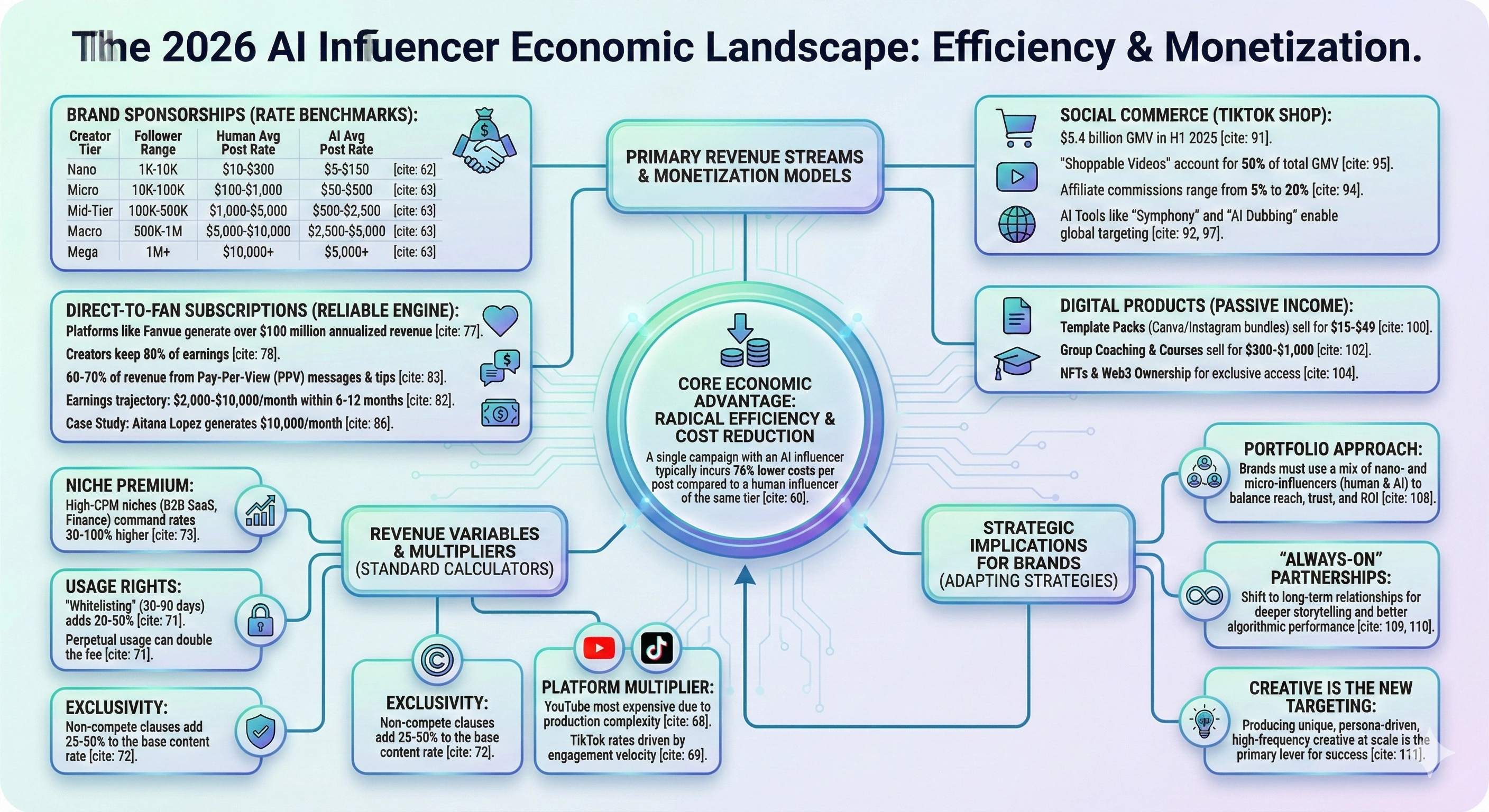
Benchmark Ranges: For sponsored content, expect ranges from $500-$50,000+ per post depending on these factors.
Contract Essentials
Ensure contracts address:
Deliverables: Precisely defined content deliverables with specifications.
Timeline: Clear production and delivery schedules with approval milestones.
Rights: Explicit rights grants as discussed above.
Approval Process: Brand approval rights and revision procedures.
Disclosure: Responsibility for regulatory disclosures.
Intellectual Property: Clear IP ownership terms.
Warranties: Representations about audience, engagement, and capabilities.
Termination: Clear termination provisions and post-termination rights.
Liability and Indemnification: Risk allocation between parties.
Campaign Execution Best Practices
Successful AI influencer campaigns require thoughtful execution.
Briefing and Creative Direction
Comprehensive Briefs: Provide detailed briefs covering:
- Campaign objectives
- Key messages
- Brand guidelines and requirements
- Product information and assets
- Creative direction and references
- Dos and don'ts
Balance Direction with Creativity: Provide clear guidelines while allowing the AI influencer team to leverage their creative strengths.
Share Brand Assets: Provide product imagery, logos, and other assets needed for quality execution.
Production Collaboration
Concept Review: Approve concepts before full production to catch issues early.
Draft Review: Build in review stages for draft content before finalization.
Revision Limits: Define reasonable revision expectations to manage scope.
Quality Standards: Set clear quality standards and expectations.
Campaign Integration
Maximize campaign impact through integration:
Coordinated Timing: Align AI influencer content with broader campaign activities.
Cross-Channel Amplification: Amplify AI influencer content through your own channels.
Paid Amplification: Consider paid promotion of AI influencer content to extend reach.
PR Integration: Leverage the novelty factor for earned media around the partnership.
Landing Page Alignment: Ensure landing pages referenced in content are prepared and aligned.
Compliance and Disclosure
Ensure compliance:
Disclosure Requirements: Ensure content includes required disclosures for both sponsored content AND AI-generated nature.
Platform Policies: Verify compliance with platform-specific requirements.
Regulatory Alignment: Align with applicable advertising regulations in relevant markets.
Measurement and Optimization
Measuring AI influencer campaign performance requires adapted approaches.
Key Metrics
Track appropriate metrics:
Reach and Impressions: How many people saw the content?
Engagement: Likes, comments, shares, saves—and engagement rate calculations.
Sentiment: What is the sentiment in comments and reactions?
Traffic and Clicks: How much website traffic resulted?
Conversions: For conversion-focused campaigns, what actions resulted?
Earned Media: What additional coverage did the partnership generate?
Brand Metrics: What impact on awareness, perception, or consideration?
Attribution Considerations
Attribution Challenges: Influencer marketing generally faces attribution challenges; AI influencer campaigns are no different.
Tracking Mechanisms: Use UTM parameters, dedicated landing pages, or unique promo codes for better attribution.
Incrementality: Consider incrementality testing for significant investments.
Benchmarking
Comparative Benchmarks: Compare performance to both AI influencer benchmarks and human influencer benchmarks for similar campaigns.
Internal Benchmarks: Over time, develop internal benchmarks for AI influencer performance.
Cost Efficiency: Compare cost-per-thousand-reached and cost-per-engagement to other channels.
Common Challenges and Solutions
Learn from common challenges in AI influencer partnerships:
Challenge: Skeptical Audiences
Issue: Some audience segments remain skeptical of AI influencer endorsements.
Solutions:
- Choose AI influencers whose audiences have demonstrated commercial engagement
- Design creative that acknowledges the AI nature rather than hiding it
- Focus on visual/aesthetic value rather than testimonial-style endorsement
- Test creative concepts before full deployment
Challenge: Quality Control
Issue: Maintaining consistent quality across content deliverables.
Solutions:
- Include specific quality standards in contracts
- Build in approval stages at concept and draft phases
- Provide detailed feedback on revisions
- Develop relationships with proven partners
Challenge: Disclosure Complexity
Issue: Navigating dual disclosure requirements for both sponsored and AI-generated content.
Solutions:
- Develop clear disclosure language approved by legal
- Include disclosure requirements in contracts
- Provide sample disclosure approaches
- Stay current on evolving disclosure requirements
Challenge: Measuring True Impact
Issue: Difficulty attributing business impact to AI influencer campaigns.
Solutions:
- Set clear, measurable objectives upfront
- Implement tracking mechanisms
- Consider brand lift studies for significant investments
- Build campaign learning into optimization
Case Study: Effective AI Influencer Campaign
Consider this illustrative example:
Brand: Premium fashion accessories brand
Objective: Launch awareness among fashion-forward Gen Z audience
Partner: AI fashion influencer with 500K followers and high aesthetic quality
Approach:
- 5-post campaign featuring product in aspirational visual scenarios
- Exclusive discount code for tracking
- Cross-posting of top-performing content on brand channels
- PR activation highlighting innovative partnership
Results:
- 2.5M total impressions across partner and brand channels
- 8.2% engagement rate on partner content
- 15+ earned media placements discussing partnership
- 45% lift in brand awareness among target demographic
- 3.2x ROAS on direct tracked conversions
The Future of Brand-AI Influencer Partnerships
AI influencer partnerships will continue evolving:
Increasing Sophistication: More sophisticated AI influencers with enhanced capabilities will offer brands more options.
Normalization: As AI influencers become more common, novelty premium may decrease while mainstream acceptance increases.
Interactive Capabilities: Real-time interaction capabilities will open new campaign formats.
Integration Depth: Deeper integrations—such as AI influencers as ongoing brand mascots or characters—will develop.
Measurement Improvement: Better measurement tools and benchmarks will emerge.
Conclusion
AI influencer partnerships offer brands unique opportunities for controlled, brand-safe, innovative marketing. Success requires understanding the distinct characteristics of this channel and adapting strategies accordingly.
At PlayBella, we work with brands seeking to leverage our family of AI creators for campaigns that push creative boundaries while delivering measurable results. Each of our collections offers different brand partnership possibilities, from the provocative Bold to the elegant Prestige.
The brands that develop AI influencer expertise now will be well-positioned as this channel matures and expands.
Interested in partnering with PlayBella's AI creators? Explore our collections and discover how we can elevate your brand campaigns.
PlayBella Team
Published on January 8, 2026