Legal Considerations for AI Creators: Rights, Regulations, and Best Practices
The legal landscape for AI creators is evolving rapidly. Understand the key legal considerations to protect yourself and operate responsibly.
The explosive growth of AI-generated content has outpaced the legal frameworks meant to govern it. AI creator operators face a complex and evolving legal landscape, where questions of copyright, disclosure, likeness rights, and regulatory compliance remain partially unsettled. Understanding these issues is essential for building sustainable, legitimate AI creator businesses.
This guide explores the key legal considerations for AI creators, providing practical guidance while acknowledging the evolving nature of this legal territory.
Disclaimer: This article provides general information for educational purposes only. It is not legal advice and should not be relied upon as such. Consult with qualified legal professionals for advice specific to your situation and jurisdiction.
Copyright and Ownership
Perhaps the most fundamental legal question for AI creators involves ownership of AI-generated content.
The Copyright Question
Traditional copyright protects original works of authorship created by humans. AI-generated content complicates this framework in several ways:
The Human Authorship Requirement: In many jurisdictions, including the United States, copyright protection requires human authorship. The U.S. Copyright Office has explicitly stated that works created solely by AI without meaningful human creative input cannot receive copyright registration.
Current Guidance: The U.S. Copyright Office has provided guidance indicating:
- Works created by AI without human creative control cannot be copyrighted
- Works with sufficient human creative input may be copyrightable
- The human creative contribution must be more than de minimis
- Registration requires disclosure of AI involvement
International Variations: Copyright treatment varies internationally:
- UK law may be more accommodating of computer-generated works
- EU frameworks are evolving with the AI Act and related legislation
- Many jurisdictions have not yet addressed AI-generated content directly
Practical Implications
For AI creator operators, these considerations mean:
Document Human Contribution: Maintain records of your creative input—prompt development, curation, editing, and creative direction. This documentation may be important for establishing any copyright claims.
Assume Limited Protection: Until legal frameworks clarify, assume AI-generated content may have limited copyright protection. Build business models that don't rely exclusively on copyright enforcement.
Contractual Protections: When licensing content, use contracts that specify rights regardless of underlying copyright status.
Platform Terms: Understand what rights platforms claim over content you post. Most platform terms include broad content licenses.
Training Data and Input Rights
Another copyright dimension involves the data used to train AI models:
Training Data Concerns: AI models are trained on large datasets that may include copyrighted material without explicit permission. Multiple lawsuits are challenging this practice.
Model Provider Responsibility: When using commercial AI tools, the model provider typically bears responsibility for training data licensing, though terms vary.
Output Liability: Questions remain about whether outputs that closely resemble training data could constitute infringement.
Due Diligence: Choose AI tools from reputable providers with clear terms about training data sourcing and indemnification.
Disclosure Requirements
As AI-generated content becomes more prevalent, disclosure requirements are expanding.
Current Regulatory Landscape
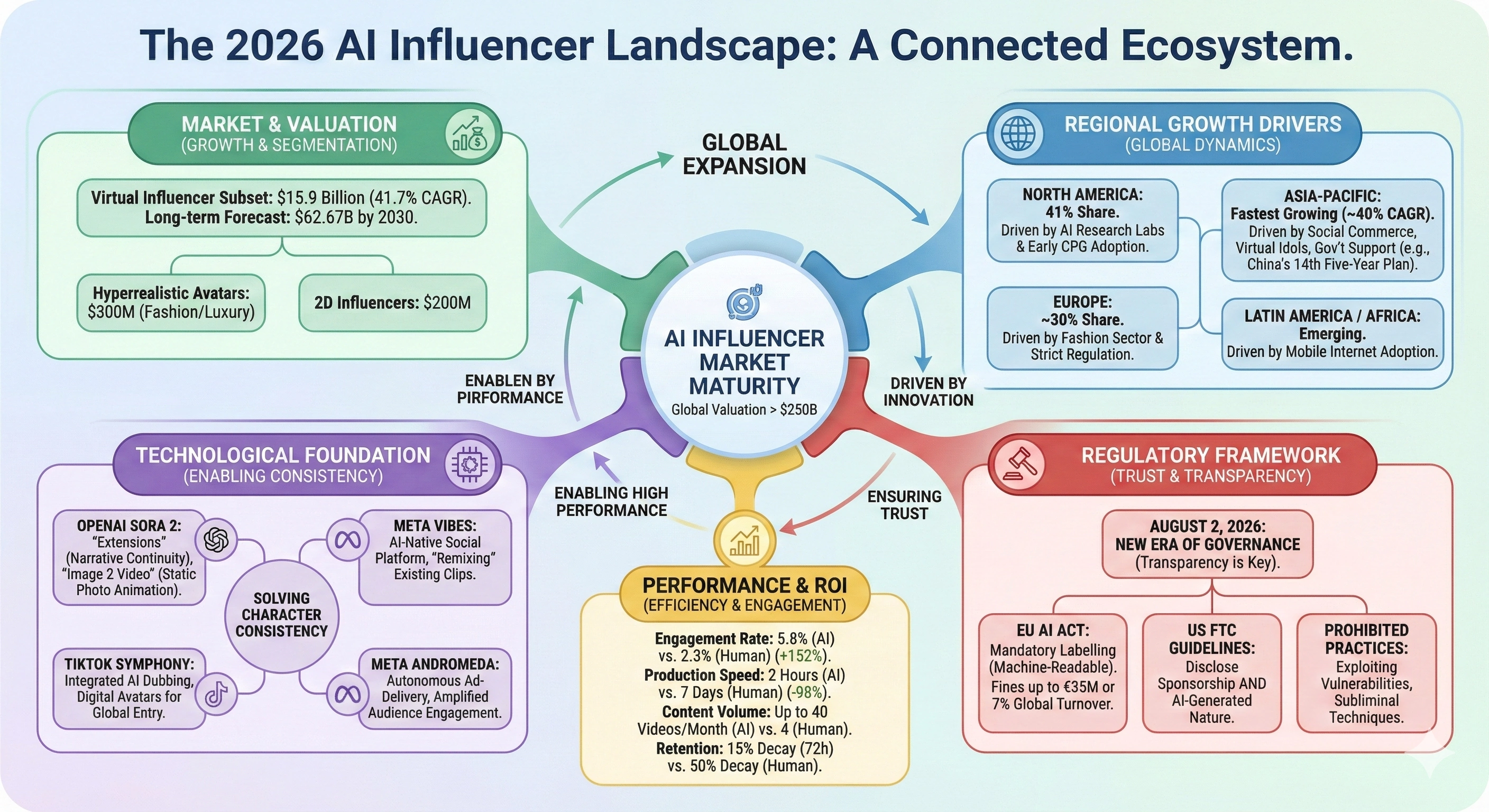
FTC Guidance (US): The Federal Trade Commission has issued guidance indicating that undisclosed AI-generated content could constitute deceptive practices, particularly in advertising contexts. While specific rules for AI influencers are still developing, the principle of non-deception applies.
EU AI Act: The European Union's AI Act includes transparency requirements for AI systems, including disclosure of AI-generated content in certain contexts. Specific implementing regulations are still being developed.
Platform Policies: Major platforms are implementing their own disclosure requirements:
- Instagram and Facebook require disclosure of AI-generated or manipulated content
- TikTok has policies on synthetic media disclosure
- YouTube requires disclosure of realistic AI-generated content
Advertising Standards: In advertising contexts, industry self-regulatory bodies increasingly require clear disclosure of AI-generated content.
Best Practices for Disclosure
Profile Clarity: Make AI nature clear in profile information. This need not be prominent but should be discoverable.
Sponsored Content Disclosure: For brand partnerships, clearly disclose both the sponsored nature AND the AI-generated nature of content.
Consistency: Apply consistent disclosure practices rather than selective transparency.
Evolving Standards: Stay current with emerging requirements and adjust practices accordingly.
Document Compliance: Keep records of disclosure practices for potential regulatory inquiries.
Likeness Rights and Personality
Creating AI characters that resemble real people raises significant legal concerns.
Right of Publicity
The right of publicity protects individuals' rights to control commercial use of their identity, including:
- Name
- Likeness (appearance)
- Voice
- Other identifying characteristics
AI-Generated Lookalikes: Creating AI characters that deliberately resemble real people without authorization can violate their publicity rights, regardless of whether the likeness is photographically accurate.
Deceased Individuals: Many jurisdictions extend publicity rights beyond death, though duration varies.
Celebrity vs. Non-Celebrity: While publicity rights apply to everyone, celebrities have more developed legal protections and are more likely to enforce their rights.
Voice Rights
Voice cloning technology raises additional concerns:
Voice as Protected Identity: Courts have found that voice can be protected under publicity rights, even without direct copying.
Authorization Requirements: Using cloned voices of real individuals without authorization risks legal liability.
Distinctive Voices: The more distinctive a voice, the more likely it is to be protected and recognizable.
Safe Practices
Create Original Characters: Design AI characters that do not deliberately resemble specific real individuals.
Obtain Authorization: If referencing real individuals, obtain explicit written authorization.
Avoid Confusion: Ensure reasonable viewers would not confuse your AI character with any real person.
Document Creative Process: Keep records demonstrating your character's independent creation.
Brand Relationships and Contracts
AI creator brand partnerships require careful contractual attention.
Key Contract Considerations
Clear Deliverable Specifications: Precisely define what content will be delivered, in what formats, and to what specifications.
Rights Granted: Clearly specify what rights the brand receives:
- Usage channels (social, advertising, etc.)
- Geographic scope
- Duration of rights
- Exclusivity provisions
Character Protection: Include provisions protecting your character's identity:
- Approval rights over how character is portrayed
- Limitations on modifications
- Quality standards requirements
Disclosure Obligations: Clarify who is responsible for required disclosures and what form they should take.
Liability and Indemnification: Establish clear liability allocation:
- Who bears responsibility for intellectual property issues
- Indemnification provisions for potential claims
- Insurance requirements if applicable
Termination Rights: Include clear termination provisions:
- What happens to content already published
- Rights that survive termination
- Post-termination restrictions
Common Pitfalls
Vague Rights Grants: Avoid broadly worded rights grants that could be interpreted expansively.
Missing Approval Rights: Ensure you retain approval authority over how your character is used.
Perpetual Rights: Be cautious about granting perpetual rights without corresponding compensation.
Bundled Rights: Understand what you're agreeing to if rights are bundled together.
Platform Terms and Policies
Operating on social media platforms subjects AI creators to various terms and policies.
Content Ownership and Licensing
Platform terms typically include:
Content Licenses: When you post content, you typically grant platforms broad licenses to use, distribute, and modify that content. These licenses usually are:
- Non-exclusive
- Royalty-free
- Transferable
- Global in scope
Account Ownership: Platforms typically retain significant control over accounts and can suspend or terminate them at discretion.
Monetization Terms: Revenue sharing and monetization programs have additional terms that may affect content rights.
AI-Specific Policies
Platforms are developing policies specifically addressing AI content:
Synthetic Media Policies: Rules about disclosure and acceptable use of AI-generated content.
Impersonation Policies: Restrictions on creating accounts that impersonate real individuals.
Content Authenticity: Requirements around representing content authenticity.
Risk Management
Policy Compliance: Actively comply with platform policies to avoid account actions.
Documentation: Maintain documentation of compliance practices.
Diversification: Don't rely exclusively on any single platform.
Appeal Preparedness: Understand appeal processes in case of account actions.
Regulatory Compliance
Beyond content-specific regulations, AI creators may face broader regulatory obligations.
Business Structure
Entity Formation: Consider forming a business entity (LLC, corporation) to limit personal liability.
Tax Obligations: Understand and comply with tax requirements for your income.
Business Licensing: Determine if any business licenses are required in your jurisdiction.
Data Protection
Privacy Regulations: If collecting personal data from audiences, comply with applicable privacy regulations:
- GDPR in Europe
- CCPA in California
- Other applicable privacy laws
Cookie Consent: Website operations may require cookie consent mechanisms.
Data Security: Implement appropriate data security measures for any personal information collected.
Industry-Specific Regulations
Certain content types trigger specific regulations:
Financial Content: Financial advice or promotion may trigger securities regulations.
Health Content: Health claims may be subject to advertising regulations.
Age-Restricted Content: Adult content on subscription platforms has specific regulatory requirements.
Risk Mitigation Strategies
Beyond specific legal compliance, broader risk management protects AI creator businesses.
Insurance
Consider appropriate insurance coverage:
Business Insurance: General business liability coverage.
Errors and Omissions: Protection against claims of mistakes or negligence.
Media Liability: Coverage for content-related claims.
Documentation Practices
Maintain thorough documentation:
Creative Process: Document your creative process to establish human contribution.
Contracts: Maintain organized records of all agreements.
Correspondence: Preserve important communications with partners and platforms.
Compliance Records: Document compliance with disclosure and other requirements.
Professional Relationships
Build relationships with professionals who can help:
Legal Counsel: Establish relationship with counsel familiar with digital media and AI issues.
Tax Professional: Work with tax professionals who understand creator income.
Business Advisor: Consider advisors who understand the creator economy.
Looking Forward
The legal landscape for AI creators continues to evolve.
Expected Developments
Copyright Clarification: Expect continued development of copyright frameworks for AI-generated content, potentially including new categories of protection.
Disclosure Requirements: Anticipate expanding and more specific disclosure requirements for AI-generated content.
Platform Policies: Platform rules will continue developing, likely imposing more requirements.
International Harmonization: Look for efforts to harmonize AI content regulations across jurisdictions.
Proactive Positioning
To position for legal developments:
Stay Informed: Monitor legal developments affecting AI creators.
Conservative Practices: When in doubt, err toward more disclosure, clearer documentation, and more cautious interpretations.
Influence Development: Consider participating in industry associations or public comment processes that shape regulations.
Adaptation Readiness: Build flexibility to adapt to changing requirements.
Conclusion
Legal considerations for AI creators are complex, evolving, and essential to understand. While uncertainty exists, responsible operators can navigate these issues by prioritizing transparency, documentation, and conservative practices.
At PlayBella, we take legal compliance seriously across our family of AI creators. Our practices reflect the principles outlined here, positioning us for long-term sustainability as the regulatory environment matures.
Building a legitimate, lasting AI creator business requires attention to these legal foundations alongside creative and commercial considerations.
For specific legal advice regarding your AI creator business, consult with qualified legal professionals in your jurisdiction.
PlayBella Team
Published on January 10, 2026